What garages here go through
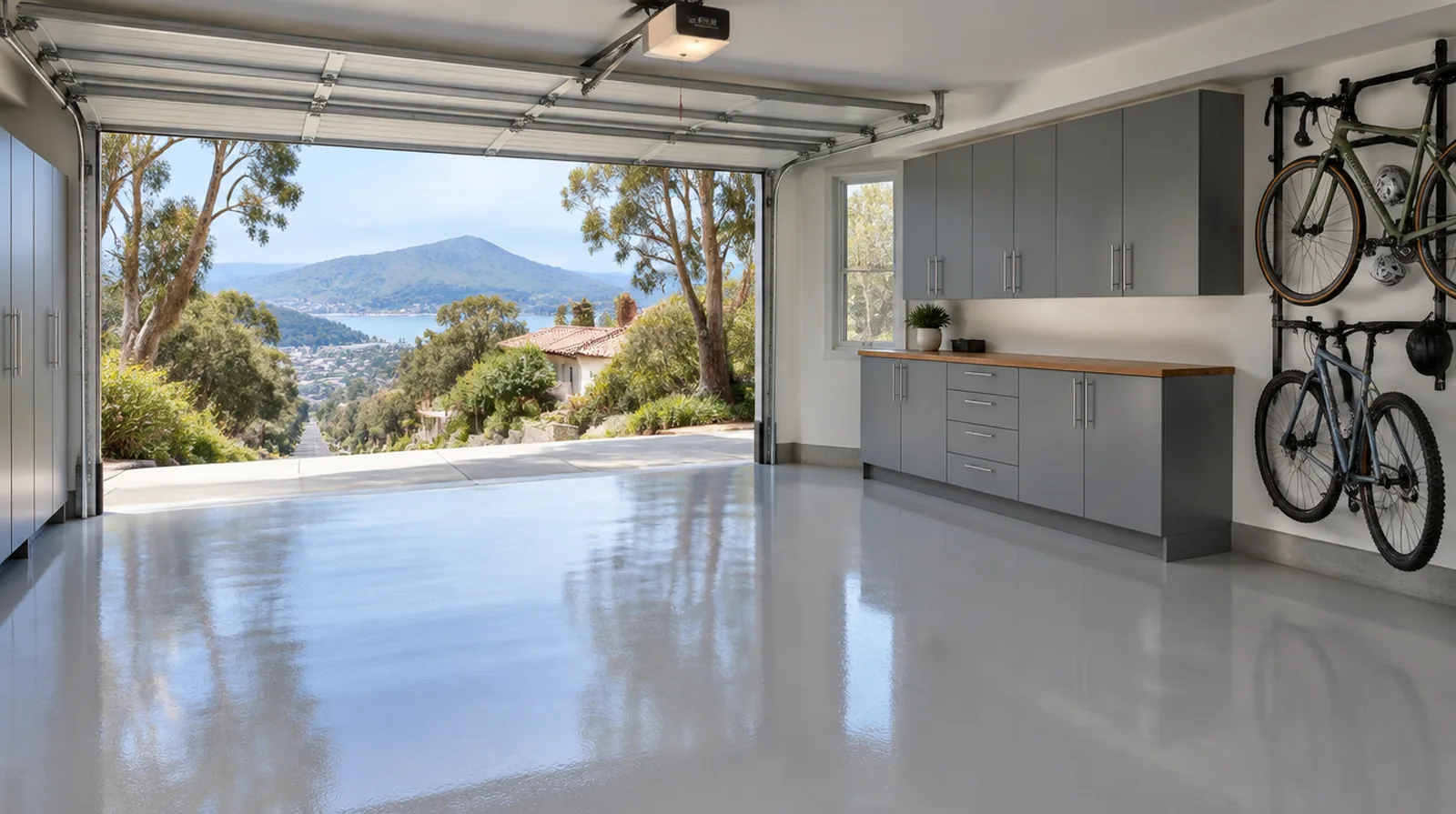
Garages in San Rafael carry more than a parked car. On the hills, many sit below the street, so every heavy rain sends water and fine silt sliding toward the door. Near the bay, slabs rest on soft fill where groundwater is never far down, and moisture vapor pushes up through the concrete all year. Salt air reaches surprisingly far inland on breezy afternoons. Add hot tires, dripping oil, dropped tools and the constant shuffle of bikes, coolers and sports gear, and you have a surface that takes a beating every day.
Bare concrete handles that poorly. It is porous, so oil and coolant soak in and leave permanent stains. The top layer is weak and dusty, so it sheds fine grit onto everything stored in the garage. Paint and cheap kits peel because they sit on top of that weak layer instead of bonding into sound concrete. A true epoxy system fixes those problems, but only when the slab is prepared correctly.
Our installation steps
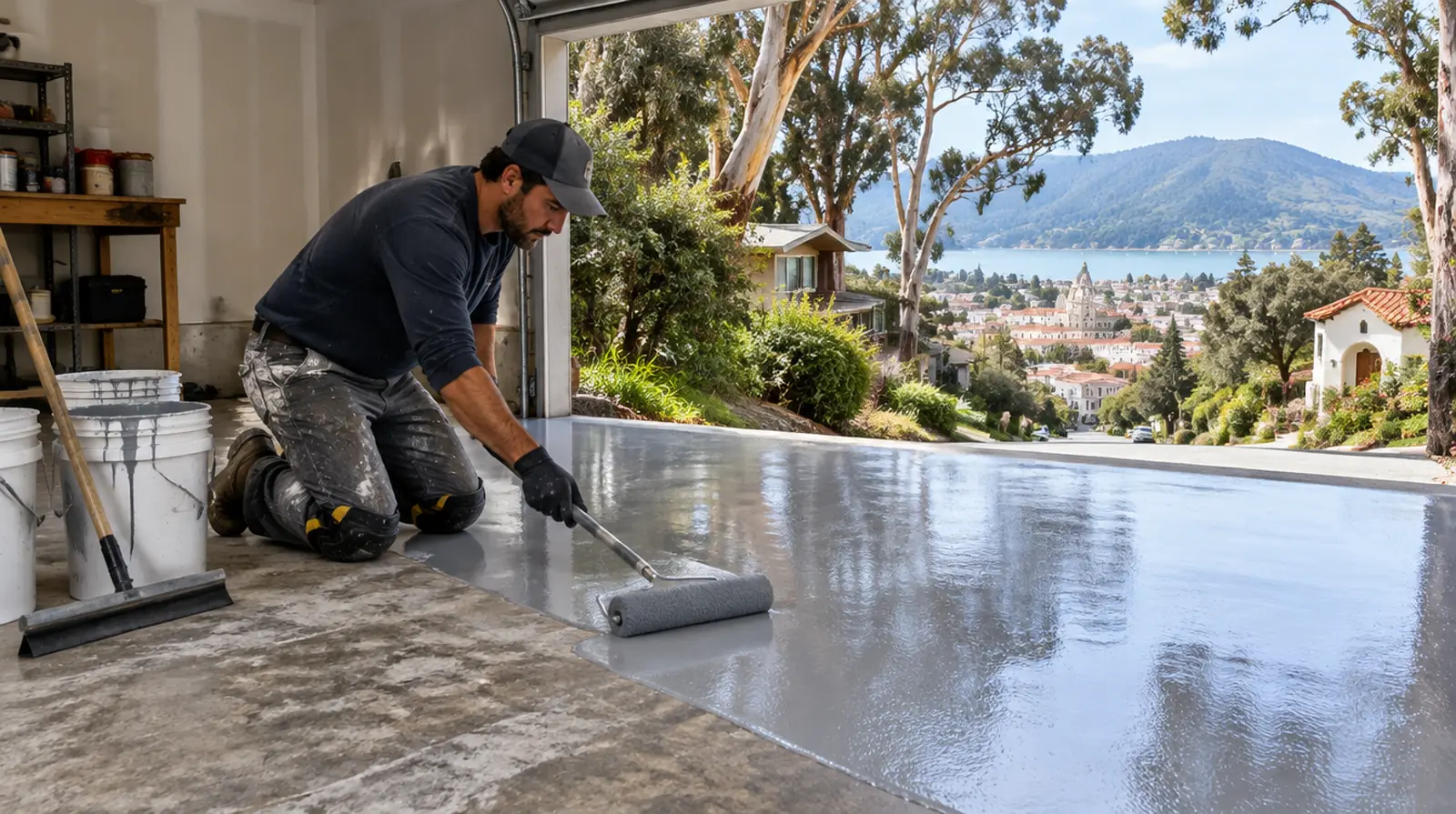
We start by moving or covering what stays in the garage and taping off walls and the door seal. Then we diamond grind the whole floor with machines tied into industrial vacuums. Grinding removes paint, sealers, stains near the surface and the weak cream layer, leaving a clean profile the epoxy can lock into. Acid etching cannot do the same job, and it leaves residue that can weaken the bond.
After grinding we repair the slab. Cracks are chased out and filled with a material chosen for whether the crack is still moving. Pits, chips and spalled edges near the threshold are patched and ground flush. Expansion joints can be filled or honored, depending on how the slab behaves. We vacuum everything, then apply a penetrating primer or a high-solids epoxy base coat. A second body coat builds thickness, and a UV-stable topcoat seals the finish so it resists yellowing near the open door.
Moisture and the bay
Before we coat any slab, we test for moisture in several places. Floors near the canal and the shoreline often show higher readings, and hillside garages can get wet along the back wall where they meet the slope. When readings are high we use a moisture-mitigating primer designed to tolerate vapor pressure. When they are extreme, we may recommend a breathable sealer instead and explain why. Skipping this step is the main reason we get called to fix floors that someone else installed only a year or two before.
Color and finish choices
Light and medium grays are the most popular. They brighten the space, make it easier to spot dropped screws and look clean beside white or gray cabinets. Tans and warm taupes suit Mission-style homes and older bungalows. Darker colors look dramatic but show dust and scratches more readily. We can add a fine aggregate to the topcoat for grip, which is helpful in garages where rain blows in or where the floor slopes toward the door. Gloss, satin and matte topcoats are all possible.
Garages that do double duty
Lots of garages in town serve as workshops, home gyms, laundry areas or storage for paddleboards and camping gear. If you lift weights, we can recommend a thicker build or mats in the lifting area. If you work on cars, a chemical-resistant topcoat handles brake fluid and solvents. If the garage doubles as a play area for kids, a textured finish makes it safer for bare feet and bikes alike. Telling us how you use the space helps us choose the right products.
Older and newer slabs
Homes near downtown and in older flat neighborhoods often have thin, patched garage slabs poured long before vapor barriers were standard. Those floors may need more crack repair and careful moisture work. Newer homes and remodels usually have thicker, smoother slabs, but they can carry curing compounds or sealers that must be removed before coating. Either way, the grinding step tells us a lot, and we adjust the plan as we see the slab open up.
Limits of a coating
Epoxy is tough, but it is not structural. It will not hold together a slab that is still heaving or sinking. If we see signs of serious settling, wide or offset cracks or soil movement under the garage, we will tell you plainly and suggest you have the structure evaluated first. Coating a moving slab wastes your money, and we would rather lose the job than install a floor we know will fail.
How long it takes
Most garages are ground, repaired and coated in one to two days. You can walk on an epoxy floor the next day, park in about three days and bring back heavy shelving after about a week once the coating fully hardens. If you need the garage back faster, ask about a polyaspartic system, which cures in hours instead of days.
Looking after the floor
Sweep or dust mop often, because grit is what slowly dulls a topcoat. Mop with warm water and a mild cleaner, and avoid harsh acids or strong citrus degreasers. Put a mat under the car where it drips, and use furniture pads under heavy equipment. Wipe up spills of oil, gas or brake fluid quickly. With that simple care, a quality epoxy garage floor keeps its look for many years.
Questions
Will the floor be slippery?
Smooth gloss can be slick when wet, so we add grip aggregate in garages that see rain or water.
Does the old paint need to come off?
Yes, in nearly every case. We grind it away so the epoxy bonds to clean concrete.
Can you work in winter?
Yes. We check slab temperature and moisture and adjust products and timing for the season.
Curious what your garage needs? Book a free estimate. If a simple sealer would do the job, we will tell you.
Get your garage floor estimate
Call (628) 304-0751 for a free estimate.